Yara Zimmermann · 3 November 2026
Mapping Data Synchronization Challenges Across Professional Networking Platforms After Infrastructure Migrations
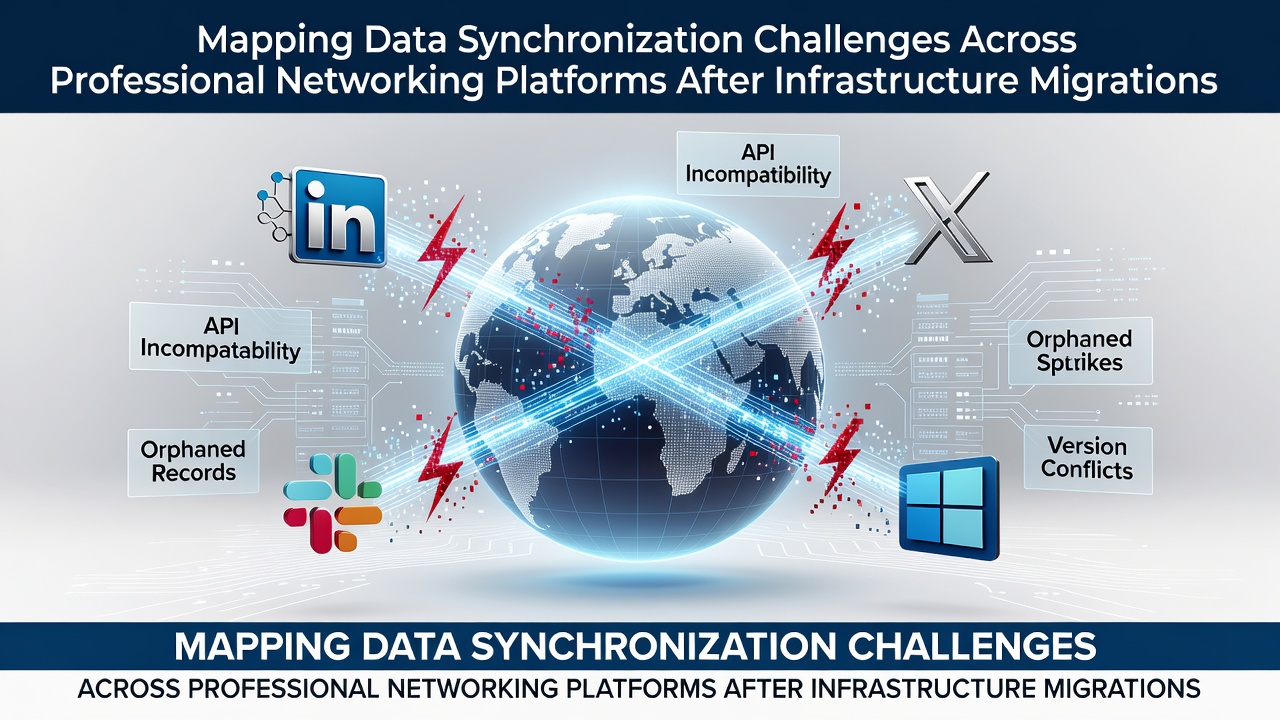
Professional networking platforms have undergone substantial infrastructure migrations in recent years, and data synchronization issues have emerged as a recurring concern for operators and users alike. These migrations typically involve shifts from legacy on-premises systems to cloud-based architectures, or transitions between cloud providers, which introduce complexities in maintaining consistent data states across distributed databases and application layers.
Core Synchronization Problems During Platform Transitions
Experts tracking these migrations note that latency spikes and eventual consistency models often clash with the real-time expectations of professional networking services. When backend systems move, profile updates, connection requests, and endorsement data may fail to propagate uniformly, leaving some users with outdated views while others see complete records. Researchers at institutions studying distributed systems have documented cases where API endpoint changes during migration created mismatches in how contact information and activity logs were reconciled across regions.
One documented pattern involves partition tolerance trade-offs under the CAP theorem, where platforms prioritize availability over strict consistency during high-traffic periods following a migration. This approach can result in duplicate profile entries or conflicting employment history details that require manual reconciliation by support teams. Data from multiple platform operators shows that such conflicts peak within the first 30 to 60 days after cutover, with resolution times varying based on the complexity of the data models involved.
Impact on User Data Integrity and Platform Operations
Observers have recorded elevated rates of notification delivery failures and message queue backlogs when synchronization scripts encounter schema differences between old and new infrastructure. Professional networking platforms handle large volumes of relationship mapping data, and any desynchronization can affect recommendation algorithms that rely on current graph structures. Figures from industry monitoring services indicate that connection acceptance rates temporarily declined on several major platforms after their 2025 migrations, correlating with periods when user actions were not immediately reflected in shared indexes.
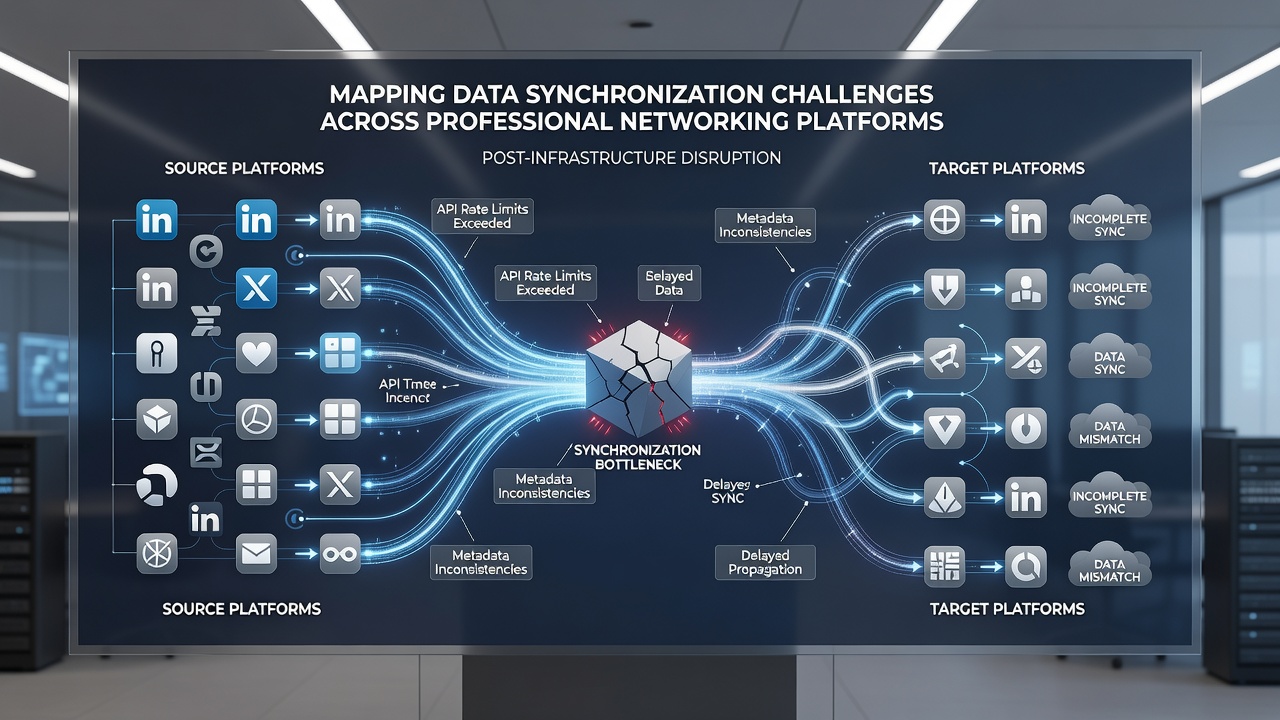
Regional differences appear in how these challenges manifest. Platforms serving European users have navigated additional constraints tied to data residency rules, while those operating in Asia-Pacific markets have reported issues with cross-border replication delays. By November 2026, several operators had implemented enhanced monitoring dashboards that tracked synchronization lag metrics in real time, allowing faster detection of drift between primary and secondary data stores.
Technical Approaches to Address Post-Migration Sync Issues
Engineering teams have adopted techniques such as change data capture streams and idempotent write operations to reduce the risk of lost updates during and after infrastructure moves. According to guidance published by the National Institute of Standards and Technology, organizations that incorporate automated conflict resolution logic early in the migration planning phase experience fewer prolonged inconsistencies in production environments. These methods include timestamp-based versioning and last-writer-wins strategies calibrated to the specific access patterns of professional networking features.
Additional measures involve phased rollouts where subsets of user data are migrated incrementally, with parallel systems running until synchronization accuracy reaches defined thresholds. Reports from the Australian Digital Transformation Agency highlight that government-linked professional directories using similar incremental approaches saw measurable reductions in post-migration support tickets related to data visibility. Platforms have also introduced user-facing reconciliation tools that let individuals verify and correct their own profile information when automated sync processes fall short.
Longer-Term Patterns Observed Across the Sector
Analysis of multiple migration events reveals that synchronization challenges tend to recur around secondary updates, such as feature additions or regulatory compliance adjustments. Those who have studied these patterns note that platforms maintaining detailed data lineage records are better positioned to trace the origin of inconsistencies when they arise months after the initial infrastructure shift. Integration with external identity providers adds another layer, since credential and affiliation data must stay aligned with internal user graphs throughout the transition.
Continued investment in observability tooling has become standard, with metrics covering replication lag, message queue depth, and cross-region consistency checks forming part of routine operational reviews. As platforms scale, the volume of interconnected data elements increases, amplifying the potential impact of any single synchronization failure.
Conclusion
Infrastructure migrations continue to test the resilience of data synchronization mechanisms within professional networking platforms, producing measurable effects on user experience and operational overhead. The patterns documented through 2026 demonstrate that proactive monitoring, incremental migration tactics, and adherence to established technical frameworks help contain these issues, though complete elimination remains elusive given the distributed nature of modern systems. Ongoing observation of synchronization performance metrics provides the clearest path for identifying and addressing emerging discrepancies as platforms evolve.